Pages

Sri Jagannath Astakam

Wednesday, 16 March 2011

KONARK SUN TEMPLE


Konark Temple
The magnificent Sun Temple at Konark is the culmination of Orissan temple architecture, and one of the most stunning monuments of religious architecture in the world. The poet Rabindranath Tagore said of Konark that 'here the language of stone surpasses the language of man', and it is true that the experience of Konark is impossible to translate into words.

The massive structure, now in ruins, sits in solitary splendour surrounded by drifting sand. Today it is located two kilometers from the sea, but originally the ocean came almost up to its base. Until fairly recent times, in fact, the temple was close enough to the shore to be used as a navigational point by European sailors, who referred to it as the 'Black Pagoda'.
Built by King Narasimhadeva in the thirteenth century, the entire temple was designed in the shape of a colossal chariot, carrying the sun god, Surya, across the heavens. Surya has been a popular deity in India since the Vedic period and the following passages occur in a prayer to him in the Rig Veda, the earliest of sacred religious text:
"Aloft his beams now bring the good, Who knows all creatures that are born, That all may look upon the Sun. The seven bay mares that draw thy car, Bring thee to us, far-seeing good, O Surya of the gleaming hair. Athwart in darkness gazing up, to him the higher light, we now Have soared to Surya, the god Among gods, the highest light."
So the image of the sun god traversing the heavens in his divine chariot, drawn by seven horses, is an ancient one. It is an image, in fact, which came to India with the Aryans, and its original Babylonian and Iranian source is echoed in the boots that Surya images, alone among Indian deities, always wear.

The idea of building an entire temple in the shape of a chariot, however, is not an ancient one, and, indeed, was a breathtakingly creative concept. Equally breathtaking was the scale of the temple which even today, in its ruined state, makes one gasp at first sight. Construction of the huge edifice is said to have taken 12 years revenues of the kingdom.

The main tower, which is now collapsed, originally followed the same general form as the towers of the Lingaraja and Jagannath temples. Its height, however, exceeded both of them, soaring to 227 feet. The jagmohana (porch) structure itself exceeded 120 feet in height. Both tower and porch are built on high platforms, around which are the 24 giant stone wheels of the chariot. The wheels are exquisite, and in themselves provide eloquent testimony to the genius of Orissa's sculptural tradition.

At the base of the collapsed tower were three subsidiary shrines, which had steps leading to the Surya images. The third major component of the temple complex was the detached natamandira (hall of dance), which remains in front of the temple. Of the 22 subsidiary temples which once stood within the enclosure, two remain (to the west of the tower): the Vaishnava Temple and the Mayadevi Temple. At either side of the main temple are colossal figures of royal elephants and royal horses.

Just why this amazing structure was built here is a mystery. Konark was an important port from early times, and was known to the geographer Ptolemy in the second century AD. A popular legend explains that one son of the god Krishna, the vain and handsome Samba, once ridiculed a holy, although ugly, sage. The sage took his revenge by luring Samba to a pool where Krishna's consorts were bathing. While Samba stared, the sage slipped away and summoned Krishna to the site. Enraged by his son's seeming impropriety with his stepmothers, Krishna cursed the boy with leprosy. Later he realized that Samba had been tricked, but it was too late to withdraw the curse. Samba then travelled to the seashore, where he performed 12 years penance to Surya who, pleased with his devotion, cured him of the dreaded disease. In thanksgiving, Samba erected a temple at the spot.

In India, history and legend are often intextricably mixed. Scholars however feel that Narasimhadeva, the historical builder of the temple, probably erected the temple as a victory monument, after a successful campaign against Muslim invaders.
In any case, the temple which Narasimhadeva left us is a chronicle in stone of the religious, military, social, and domestic aspects of his thirteenth century royal world. Every inch of the remaining portions of the temple is covered with sculpture of an unsurpassed beauty and grace, in tableaux and freestanding pieces ranging from the monumental to the miniature. The subject matter is fascinating. Thousands of images include deities, celestial and human musicians, dancers, lovers, and myriad scenes of courtly life, ranging from hunts and military battles to the pleasures of courtly relaxation. These are interspersed with birds, animals (close to two thousand charming and lively elephants march around the base of the main temple alone), mythological creatures, and a wealth of intricate botanical and geometrical decorative designs.
The famous jewel-like quality of Orissan art is evident throughout, as is a very human perspective which makes the sculpture extremely accessible. The temple is famous for its erotic sculptures, which can be found primarily on the second level of the porch structure. The possible meaning of these images has been discussed elsewhere in this book. It will become immediately apparent upon viewing them that the frank nature of their content is combined with an overwhelming tenderness and lyrical movement. This same kindly and indulgent view of life extends to almost all the other sculptures at Konark, where the thousands of human, animal, and divine personages are shown engaged in the full range of the 'carnival of life' with an overwhelming sense of appealing realism.

The only images, in fact, which do not share this relaxed air of accessibility are the three main images of Surya on the northern, western, and southern facades of the temple tower. Carved in an almost metallic green chlorite stone (in contrast to the soft weathered khondalite of the rest of the structure), these huge images stand in a formal frontal position which is often used to portray divinities in a state of spiritual equilibrium. Although their dignity sets them apart from the rest of the sculptures, it is, nevertheless, a benevolent dignity, and one which does not include any trace of the aloof or the cold. Konark has been called one of the last Indian temples in which a living tradition was at work, the 'brightest flame of a dying lamp'. As we gaze at these superb images of Surya benevolently reigning over his exquisite stone world, we cannot help but feel that the passing of the tradition has been nothing short of tragic.

Close by is one of the most attractive beaches of the world - the Chandrabhaga beach.
Approach : By air to Bhubaneswar, Konark is 65 km from Bhubaneswar & Puri to 30 km by road.

Stay : While many visitors prefer to stay at Puri or Bhubaneswar and make a day trip to Konark, excellent accommodation is available at Konark at the Panthanivas Hotel & Lodge.
Hotel Name
Telephone No
Panthanivas
(06758) 235831
Yatrinivas
236821

Fairs and Festivals of the region
 :
 Magha Saptami which is also called Chandrabhaga Mela is the most popular festival (in the month of February) when lakhs of pilgrims from various parts of India and abroad visit this place. Tourism festival known as Konark Dance Festival is held here from 1st-5th December every year in the "Open Air Auditorium" with the Sun Temple as the back drop.
Places around Konark
Kuruma
Chaurasi
Ramachandi
Astranga
  
* Distance from Konark
Kuruma
(8 km)*

 
8 km from the world famous Sun Temple of Konark, Kuruma is a small village. Recent excavations here have brought to light the reminiscence of some ancient Buddhist antiquities like the image of Buddha seated in Bhumisparsa Mudra along with the image of Heruka, and a 17 metres long brick wall (brick size: 22 cm X 17 cm). Scholars are of opinion that this was one of the sites containing Buddhist stupas described by Hiuen T'sang. The place is approachable by jeep.
Chaurasi
(14 km)*
 
14 km from Kakatpur and 30 km from Konark one can visit the shrines of Amareswar, Laxminarayan and Barahi at Chaurasi.
Barahi is the Mother Goddess with the face of a boar. Pot-bellied, she holds a fish in one hand and a cup in the other. The deity belongs to 9th century A.D. and is worshipped according to tantric practices
Ramachandi
(7 km)*
 
On the confluence of the river Kushabhadra and the Bay of Bengal, Ramachandi, the presiding deity of the Konark region is worshipped here with reverence. On the Marine Drive, the place is ideal for week-end picnic.
Astranga
(35 km)*
Right on the sea-shore, it is 91 km from Puri and 10 km from Kakatpur. Astaranga presents a panoramic view especially during sunset on a multi-coloured horizon as if to justify the literal meaning of its name. It is a centre of salt production and fishing.

Temple of Goddess Harachandi


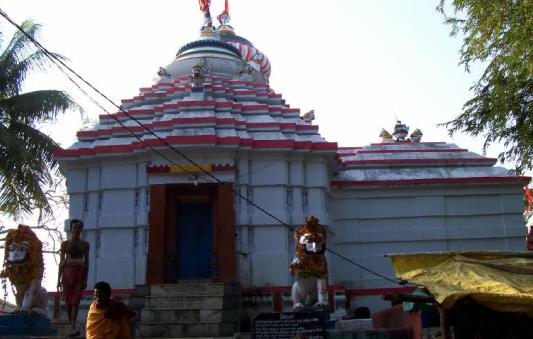
Puri, the abode of Lord Jagannath, which is celebrated as a Vaisnava centre is also famous for its Sakta temples. Both inside and outside the premises of famousJagannath temple there are several temples dedicated to Sakta deities such asRamachandi, Laksmi, varahi, Harachandi, Daksina Kali, Shyamakali, etc. which indicates the popularity of Saktism at Puri. There is a temple dedicated to goddess Harachandi at 27km south west of Puri on the national highway 203 leading from Puri towards Brahmagiri and Satapada. On this road there is a place known as Kathuari chowk, from this chowk take a left diversion and after 5 kilometers you will reach village Palanka, this temple is located at a distance of 1 kilometer from the village Palanka. This temple is dedicated to Goddess Durga and is mounted on a sandy hill near the ocean. The exact geographical location of this temple is LONGITUDE 85041’39” E and LATITUDE 19045’28” N.
The temple is facing towards the east and the presiding deity is Asta-Bhuja (Eight-Armed) Mahisamardini Durga worshipped as Baliharachandi. Baliharachandi is also regarded as goddess of water and navigation, who protects the boatsman and fisherman, when confronted with danger in the sea. This temple has relation with the Sri Jagannath temple in respect of a ritual on the Mahanavami day in the month of Ashwina. Festivals like Navaratri, Durga Puja, Chaitra Mangala Bara, Ramanavami etc. are observed in this temple with great devotion. An image of Goddess Kali is found at the base of the back Rahapaga of the Baliharachandi temple near Puri. Here Kali holds a serpent. She holds a skull and a severed head by her left hands. She stands in Alidha pose on the body of Lord Siva. Baliharachandi temple is a protected monument of Orissa State Archaeology and under the Endowment Department, Government of Orissa.
Baliharachandi temple located at the beginning of the river Bhargavi is not just a pilgrim site but also a scenic spot. This place is also famous for stretches of sandy beach and the meeting point of river Bhargavi with the Sea. It attracts lots of tourist to enjoy the natural site of beach and to seek divine blessings and eternal happiness. The sunrise and sunset scene of beach is amazing for touristis. The tourists can also enjoy sunbath on the calm and quite sea beach of Baliharachandi. The scenic beauty of this place is ideal for group picnic. Baliharachandi, the well known tourist destination of Orissa, is worth a visit.

SHRI LOKANATHA TEMPLE

Shri Lokanatha TempleThe temple of Shri Lokanatha is situated at a distance of about 2½ kms to the west of Lord Jagannatha temple of Puri. This temple is one of the most important Shaiva shrines of Orissa. As per local people this temple was established by Lord Ramacandra. From the architectural point of view the temple is not so important but from the religious point of view, it occupies an important position in the cultural history of Orissa. The legend says that Lord Rama on his way to Sri Lanka for searching Sita reached Puri and sat with a vow to see Siva here. At that time there was a village (koown as Sabarapalli in local language) nearby. Sabaras (native of that village) presented him a Lau or Lauka (Pumpkin, one type of vegetable) looking like a Siva Linga, Lord Rama installed that as the replica of Siva Linga at that place and prayed Siva to fulfill his desire. From that day this Siva Linga was called 'Laukanatha'. It is believed that the word Lokanatha is a later innovation from the original word 'Laukanatha'.
The innermost chamber of the main temple preserves a Shiva linga which is the presiding deity of the temple. This linga is visible to the devotees once in every year. The sanctum including the linga is filled with water throughout the year by a natural fountain. In the night of Pankoddhar Ekadashi (3 days before the famous Shivaratri festival) all the water is bailed out and the Shiva Linga becomes visible and thousands of devotees enable to worship the Lord. According to a local tradition, people who suffer from incurable diseases come here for prayer. The flowers, sandal paste, milk, Curd (yoghurt), honey, beetle leaves, Coconut water, bilva leaves, etc. offered to the God throughout the year remain decomposed in the water creating a special smell and taste being medicated as a whole. people take it as Prasad, in order to be cured from the disese that they suffered for.
The Lokanatha temple has four parts such as Vimana (Main Temple), Jagamohana (Entrance Hall), Natamandapa (Dancing Hall) and Bhogamndapa (Offering Hall). This temple is built in sand stones. The main temple is about 30 feet from the ground level. Most portions of the main temple have been covered with marbles, so the detail architectural features of the main temple are not visible. The outer walls of the main temple housed images of different Deities. The image of Shiva-Parbati is carved on the northern side wall. There is image of Lord Kartikeya on the eastern side wall. The image of four handed Lord Ganesha is carved on the southern side wall. All these side wall images are housed inside small temples. Many small temples are there inside the premises of Lokanatha temple. There is a small temple to the left of the inner courtyard which preserves images of Surya-Narayana and Candra-Narayana. The Satya-Narayan temple within the premises preserves images of Vishnu, Laksmi and several brass idols. On the right side of the entrance to the inner courtyard you will find a figure of Lord Hanuman. The compound of the Lokanatha temple is about 10 feet below the road level. When you enter the lokanatha temple compound by climbing down the stairs from the main road, you will find a big pond (known as Parvati Sagara in local language) at your right side. Devotees wash their hands and feets in this pond before entering into the temple. This pond houses a lot of fishes. Devotees enjoying a lot by offering foods to these fishes.
Lord Lokanatha's representative image is in the Sri Jagannatha temple, known as Bhandara Lokanatha. He is the guardian deity of the Ratnabhandara (treasure house) of Sri Jagannatha temple. Lokanatha is associated with Lord Jagannath in several festivals like Sivaratri, Candan Yatra and Sital Sasthi. The festival of Shivaratri is observed in the temple of Lokanatha with great devotion. A meeting of Hari and Hara (Siva and Vishnu) takes place on the day. On the Mahashivaratri lot of devotees arrive near the temple to offer their prayer to Lord Lokanatha with great devotion.

puri


Jagannath Temple
Puri
One of the four celebrated religious centers of India, Puri, the abode of Lord Jagannath needs no introduction. According to tradition Puri was once a thickly wooded hill inhabited by the Sabaras (Pre-Aryan and Pre-Dravidian tribes of the Austric linguistic family). The sunny beach at Puri is one of the finest in the world. Watching the sunrise in a symphony of colours is a wonderful experience. It is one of the most popular sea-side resorts where visitors from any part of the globe can comfortably relax.

Places of tourist interest in Puri : The Temple of Lord Jagannathbuilt during the 12th century A.D. by Chodaganga Deva dominates the landscape for kilometers around. Being the tallest temple (65 metres) in Orissa, it is one of the most magnificent pieces of monuments of India. In front of the main gate stands a 16 sided monolithic pillar (11 metres high), called Aruna Stambha which formally stood in front of the Sun Temple and was brought to Puri during the 18th century A.D. Some of the other important temples are Gundicha, Lokanath, Sunaragauranga, Daria Mahabir and Tota Gopinatt. There are also a number of holy tanks like Narendra, Markandeya, Sweta Ganga and Indradyumna. There are many Monasteries locally known as Mathas also of touristic interest.
Approach : By air to Bhubaneswar (Puri is 62 km from Bhubaneswar), road and rail.

Stay : Stay arrangements can be done with the local hotels & Dharmashala and in Guest House  Puri. The list of hotels with their phone numbers is given below:
Hotel Name 
Telephone (06752)
Hotel Swimming
06752-254434,254243
Hotel Sonar Kella
06752-230617
Hotel Mayfair Beach Resort
224041, 224254, 224313
Hotel New Victoria Club
06752-222005, 222583
Shree Purusottam Vatika A/C
06752-226227
Hotel Nayak Plaza (Grand Road)
06752-232585
Nilachal Bhakta Niwas
06752-222053
Puri Hotel
06752-222114, 222744
BAPS Swaminarayan Atithi Niwas
                            06752-227999

Dharmashala Name
Telephone (06752)
Bagala Dharmashala(Govt.)
06752-223235,
Ramachandra Goenka Dharmashala
06752-223678
Duduwala Dharmashala 
06752-223380
Tularam Sujanamal Bagedia Dharmashala
06752-223224
Bharat Sevasram Sangha
06752-223227
Nilanchal Goudiya Math
06752-231474

Places around Puri
Balighai 
Brahmagiri 
Satyabadi 
Baliharachandi 
Raghurajpur 
Satapara 
* Distance from Puri *

Balighai
(8 km)*
The Casuarina fringed Balighai beach is a famous picnic spot. The Sun and fun at the mouth of the river Nuanai is unforgettable.
Brahmagiri
(25 km)*
Brahmagiri is known for the living shrine of Alarnath. Streams of pilgrims visit Alarnath during Anabasara of Lord Jagannath. Nearby is the shrine of Baliharachandi on the solitary sand dunes.
Satyabadi
(20 km)*
Satyabadi or Sakshigopal is known for the shrine of Lord Sakshigopal. It is believed that the visit to Puri is incomplete without a visit to Sakshigopal. The temple is only 2 km away from the main road leading to Puri and is convenient to visit.
Baliharachandi
(27 km)*
27 km to the south-west of Puri is the temple ofBaliharachandi. Situated on a sandy hill near the sea and adjacent to the mouth of the river Bhargavi, Goddess Durga is worshipped here as Baliharachandi. The scenic beauty of this place is ideal for group picnic.
Raghurajpur
(16 km)*
 
One of the most famous artists village in Orissa, the village of Raghurajpur boasts not only of the exquisite pattachitra's and talapattachitra's, but also of being the native place of Guru kelucharan Mohapatra, the famed Odissi dancer. Even today, under the tutelage of renowned Guru's, young boys can be seen practicing the Gotipua dance here. A visit to Orissa would definitely be incomplete without a visit to this little village.
Satapara
(52 km)*
 
Satapara, a retreat in nature on Chilika Lake, has been thrown open to visitors. Its location near the confluence of the Lake with the Bay of Bengal, and proximity to Puri (52 km), makes it an ideal spot to enjoy Chilika. The thrilling sight of dolphins round the year and abundance of migratory and resident birds in winter make it a preferred place for a vacation with nature.